

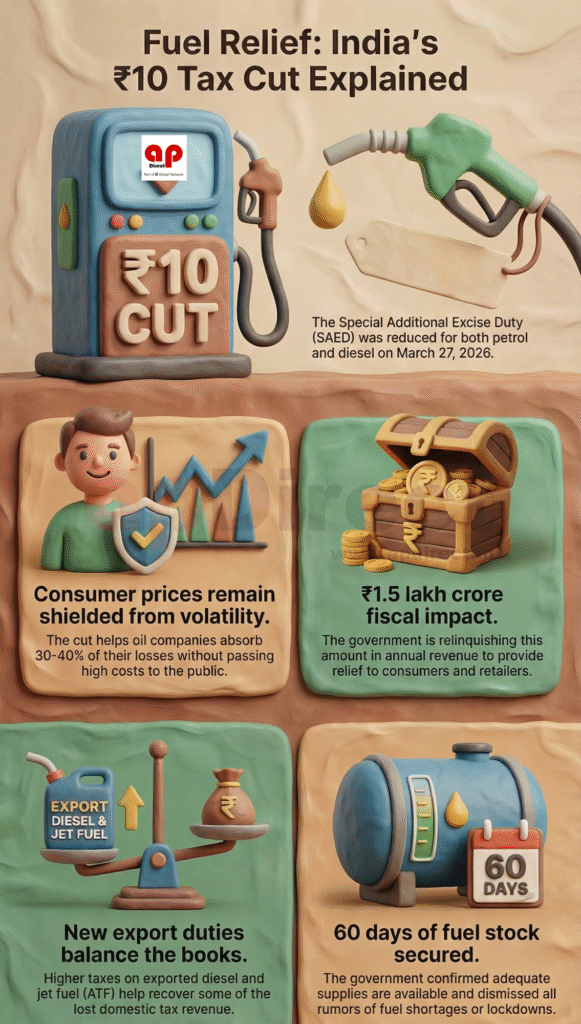
Based on the government notifications and the economic analysis of the March 2026 orders. The primary tool the government is using is the Special Additional Excise Duty (SAED), commonly known as the windfall tax.
- The Logic: When international oil prices skyrocket, oil producers (like ONGC) and refiners (like Reliance) make “supernormal profits” simply because the global market price is high, not because their production costs changed.
- The Adjustment: The government reviews these rates every 14 days. If global prices rise, the tax stays or increases; if global prices soften (as seen in the initial Hindu report), the tax is slashed to provide relief.
The order creates a two-tier system to prevent a domestic fuel shortage:
- For Domestic Sale: By cutting the SAED to ₹3 on petrol and zero on diesel, the government is “absorbing” the losses that Oil Marketing Companies (OMCs) were facing. This allows OMCs to keep your pump prices steady even though they are buying crude oil at $120+ per barrel.
- For Exports: The government has simultaneously imposed/maintained high Export Duties (₹21.5/litre for diesel and ₹29.5/litre for ATF).
- Why? This makes it less profitable for Indian refiners to send their fuel abroad to capture high global prices, forcing them to prioritize the Indian market first.
- For the Government: They are taking a calculated fiscal hit of approximately ₹1.5 lakh crore in lost revenue. The government is essentially using their tax “buffer” to prevent inflation from hitting the common man.
- For Oil Companies: Public sector companies (IOCL, BPCL, HPCL) get a “breather.” Instead of losing ₹24–30 on every litre they sell, the tax cut reduces that loss by about 40%, making their business more sustainable during the war-induced price spike.
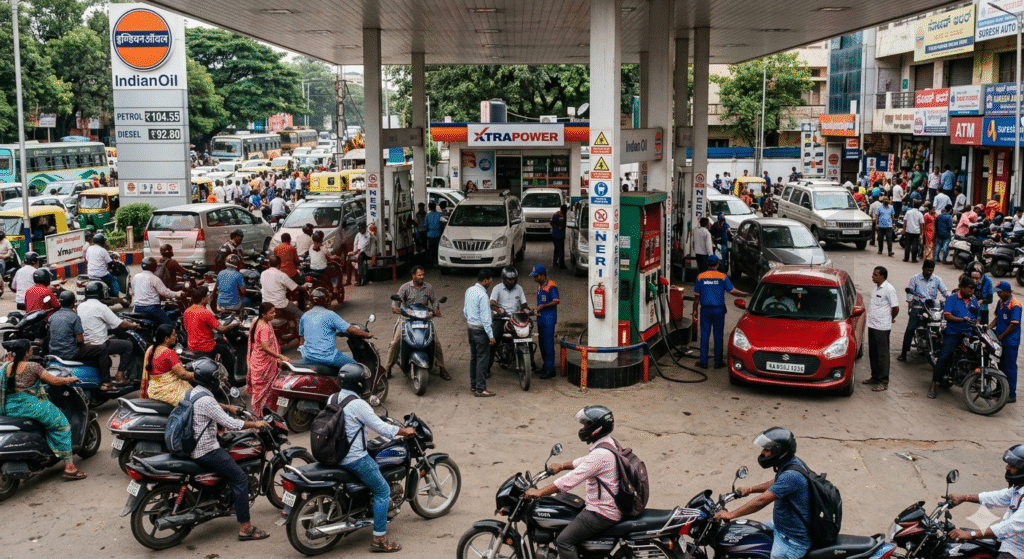
- For the Consumer: there are no change at the pump. In a normal market, $120 oil would have sent petrol prices well above ₹120–130 per litre. This order “freezes” the price by removing the government’s tax take.
1. Impact on Oil Marketing Companies (OMCs)
- Burden Sharing: Before this cut, public sector OMCs (like IOCL, BPCL, and HPCL) were incurring massive losses—roughly ₹24 per litre on petrol and ₹30 per litre on diesel—because they had not raised retail prices despite global crude hitting $122/barrel.
- Financial Relief: This tax cut absorbs about 30–40% of those losses. It prevents the OMCs’ financial health from deteriorating further without forcing them to hike prices at the pump.
- Inventory Security: To ensure supply, the government has allowed OMCs to increase credit to petrol pumps (from 1 day to 3 days) to solve working capital issues.
2. Impact on Customers (The General Public)
For most Indians, the immediate impact is price stability. Instead of prices “going through the roof” as they have in Europe or North America, retail prices for regular fuel remain unchanged.
- Countering Panic: The government explicitly moved to dispel “lockdown rumors” and confirmed that India has enough crude and fuel stocks for 60 days, urging citizens to avoid panic buying.
- Private vs. Public: While public OMCs kept prices steady, private retailers (like Nayara Energy) had already begun raising prices by ₹3–₹5 per litre. This tax cut helps level the playing field.
3. Impact on Government Finances
- Revenue Loss: This is a “bold and visionary” but expensive move. The government is losing an estimated ₹1.5 lakh crore to ₹1.6 lakh crore in annual revenue due to this cut.
- Balancing the Books: To partially offset this loss, the government has imposed export duties (₹21.5/litre on diesel and ₹29.5/litre on ATF). This serves two purposes:
- It generates some replacement revenue.
- It discourages companies from exporting fuel, ensuring domestic availability during the West Asia crisis.
With global prices up 50% in a month (due to conflicts in the gulf, the government had to choose between a massive inflationary shock to the economy or taking a massive hit to its own treasury. The government chose the latter to insulate citizens from global volatility.