

NEW DELHI, March 30, 2026 — In a major move to bolster energy security and streamline urban infrastructure, the Ministry of Petroleum and Natural Gas has issued the Natural Gas and Petroleum Products Distribution (Through Laying, Building, Operation and Expansion of Pipelines and Other Facilities) Order, 2026 [1, 2]. The order introduces strict timelines for infrastructure approvals and a “deemed permission” clause to eliminate delays in laying essential gas pipelines [3-14].
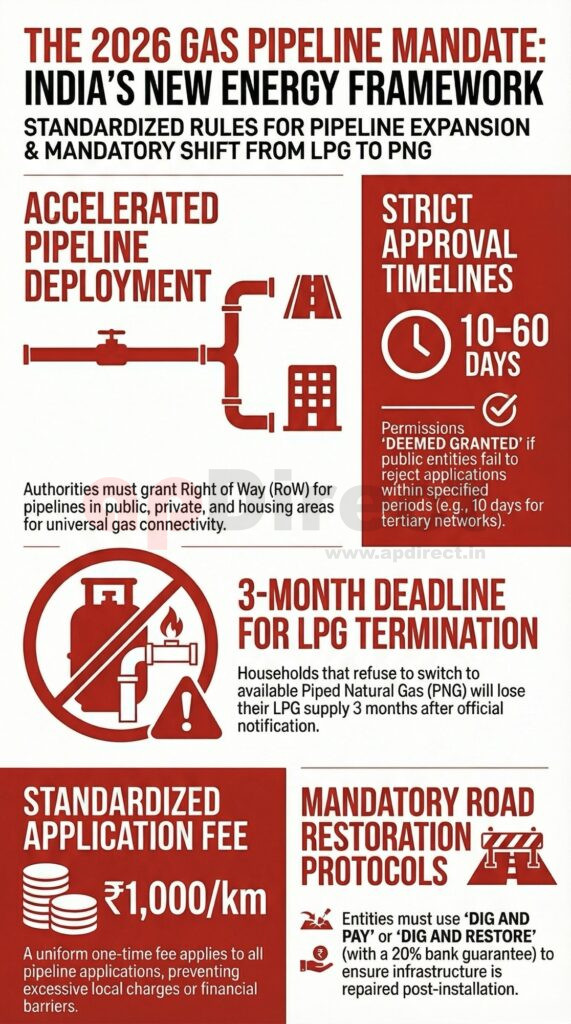
Mandatory Transition to Piped Natural Gas (PNG)
The most significant impact of the new order is on domestic consumers. The government aims to increase the supply of natural gas through pipelines to release Liquefied Petroleum Gas (LPG) for areas that lack pipeline connectivity [15, 16].
Under the new rules, if a housing area is PNG-ready and an authorized entity has issued a notice to households to switch, residents have three months to apply for a PNG connection [17, 18]. Failure to do so will result in the cessation of LPG supply to that address [17, 18]. Exceptions will only be made if the authorized entity issues a No Objection Certificate (NOC) stating that a piped connection is “technically infeasible” [19-21].
Strict Action Against Access Denials
The order directly addresses “impediments” such as Resident Welfare Associations (RWAs) or individuals denying access to land for pipeline work [22, 23]. If a relevant entity in a housing area fails to grant the necessary “Right of Way” within set timelines, authorized gas companies are now empowered to:
- Notify designated government officers [24, 25].
- Issue public notices identifying the addresses [24, 25].
- Inform Oil Marketing Companies to stop LPG supply to the entire housing area within three months [26, 27].
Fast-Track Approvals and “Deemed” Permission
To prevent project stalling, the government has established rigid timelines for public entities to approve or reject pipeline applications, ranging from 10 to 60 working days depending on the pipeline’s diameter and length [4-8, 10-14].
If a public entity fails to respond within these periods, permission is deemed to have been granted [3, 9]. In such cases, the gas company can proceed with the work after publishing a public notice in local newspapers [3, 9, 28]. To simplify the process, a uniform one-time application fee of Rs. 1,000 per kilometer has been set for both overground and underground pipelines [29, 30].
Restoration and Compensation
The order clarifies how roads and public lands must be repaired. Public entities can choose between a “Dig and Pay” model—where the gas company pays a fixed fee (e.g., Rs. 5,000/meter for concrete roads) for the authority to handle repairs—or a “Dig and Restore” model, where the company performs the repairs themselves and provides a performance bank guarantee [31-39].
For non-public (private) areas, the order mandates that gas companies enter into agreements with landowners for mutually agreed compensation [40, 41]. If an agreement cannot be reached and no alternate route exists, a Designated Officer (such as a District Magistrate) can intervene, hold a hearing, and grant the necessary permissions while determining fair compensation [42-50].
Global Context and Energy Security
The Central Government cited long-term energy security as the primary driver for these changes [51, 52]. The order highlights “extensive damage” to liquefaction facilities in the Gulf region and the “continued blockage of the Strait of Hormuz” as critical events requiring immediate fuel diversification to protect India’s energy interests [51, 52].
The Petroleum and Natural Gas Regulatory Board (PNGRB) has been designated as the nodal agency responsible for compiling data and ensuring compliance with the new order [53, 54].