
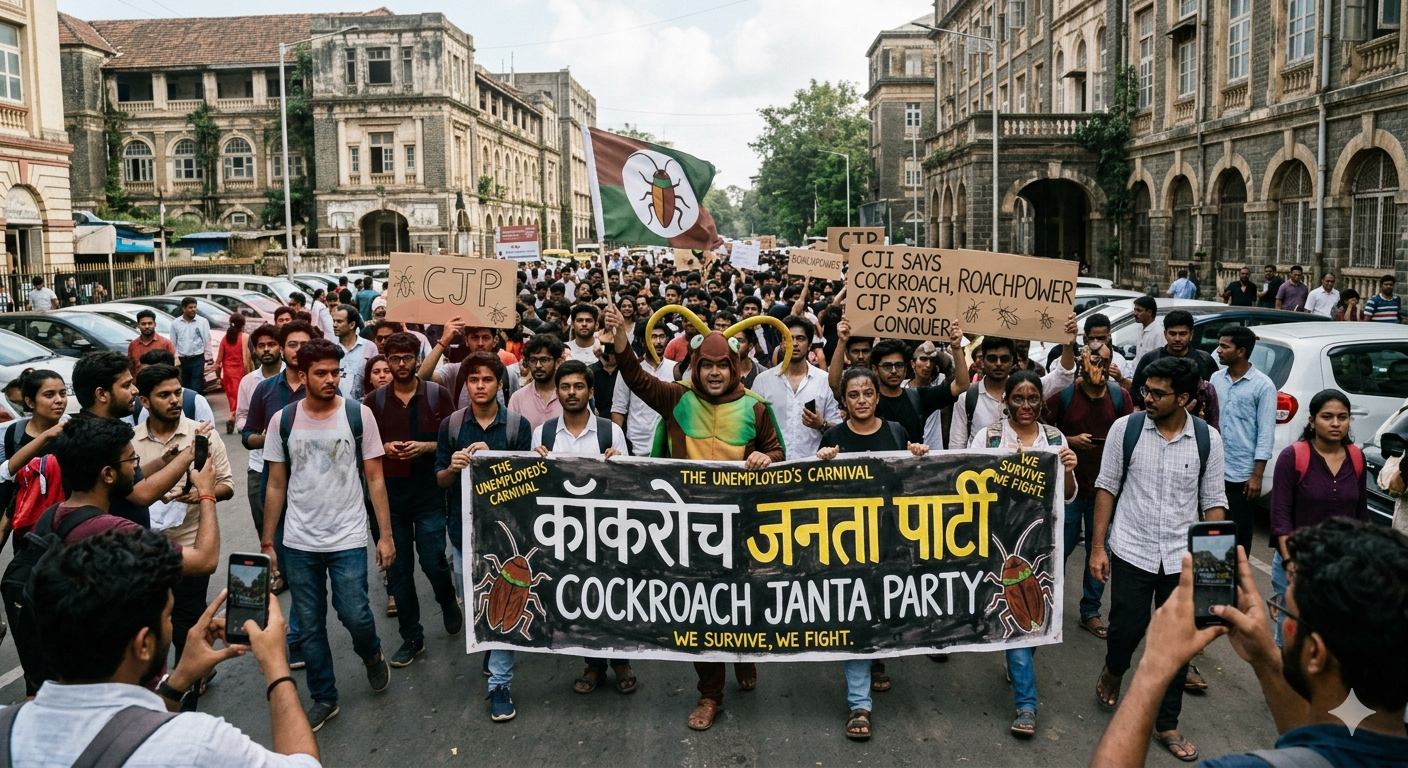
In mid-May 2026, a seemingly innocuous comment during a Supreme Court hearing triggered one of the most rapid viral movements in recent Indian history. Chief Justice of India Surya Kant, while addressing criticism regarding the judiciary, compared some unemployed youth to “cockroaches” and “parasites” who attack the system. Rather than recoiling from the label, India’s youth claimed it, transforming an intended insult into the foundation of a new satirical political movement: the Cockroach Janta Party (CJP).
The Genesis of a Movement
Founded on May 16, 2026, by political communications strategist Abhijeet Dipke, the CJP was never intended to be a registered political party. Instead, it emerged as a digital “carnival”—a space for protest, mockery, and venting. Within days of its launch, the movement exploded on social media, with its Instagram following reportedly surpassing that of the ruling Bharatiya Janata Party (BJP).
The movement’s aesthetic is built on absurdist humor. By adopting the cockroach—an insect synonymous with survival in harsh conditions—as its symbol, the CJP created a powerful metaphor for the endurance of India’s disillusioned youth.
Manifesto and Demands
While the party’s membership criteria—self-described as “unemployed, lazy, and chronically online”—are tongue-in-cheek, the CJP has utilized its platform to articulate serious grievances. Its manifesto includes several pointed policy demands:
- Judicial Accountability: A ban on post-retirement Rajya Sabha seats for Chief Justices to prevent potential conflicts of interest.
- Electoral Integrity: Prosecution under the Unlawful Activities Prevention Act (UAPA) for any Chief Election Commissioner who permits the deletion of legitimate votes.
- Political Reform: A 20-year ban on electoral politics for any MLA or MP who defects from their party, aiming to curb political opportunism.
- Gender Equality: A 50% reservation for women in Parliament, with a requirement for current male legislators to vacate seats rather than simply expanding the house.
Activities and Impact
The CJP’s primary influence remains its digital footprint. Through a steady stream of memes, viral videos, and biting social media commentary, it has become a central hub for frustration regarding:
- Economic Disenfranchisement: Widespread anger over unemployment and the rising cost of living.
- Systemic Inefficiency: Protests against corruption in public examinations and recruitment drives.
- Digital Resistance: The movement has faced platform restrictions and censorship, which, following the “Streisand Effect,” has only served to fuel its growth and popularity among younger demographics.
While the movement is primarily digital, it has begun to bridge the gap between online discourse and physical action. Volunteers have been seen participating in clean-up drives and public demonstrations while wearing cockroach costumes. Founder Abhijeet Dipke has also announced plans to return to India from the United States to lead physical protests, specifically targeting government figures like the Education Minister.
The Road Ahead
The CJP is often compared to the 2011 “India Against Corruption” movement, yet experts note a fundamental difference: the CJP is fueled by a generation that speaks the language of modern digital dissent.
Political analysts remain divided on the movement’s long-term trajectory. Some argue that the CJP is a “canary in the coal mine,” signaling deep-seated structural issues that the government must address. Others suggest that the ruling party may eventually seek to “co-opt” the movement’s populist demands to neutralize its influence. Whether the Cockroach Janta Party matures into a sustained political force or remains a transient, albeit powerful, meme-driven protest depends on its ability to translate its massive online following into tangible, consistent real-world impact.